
I wasn't really talking about rugby
What a short speech about rugby taught me about engaging any audience.

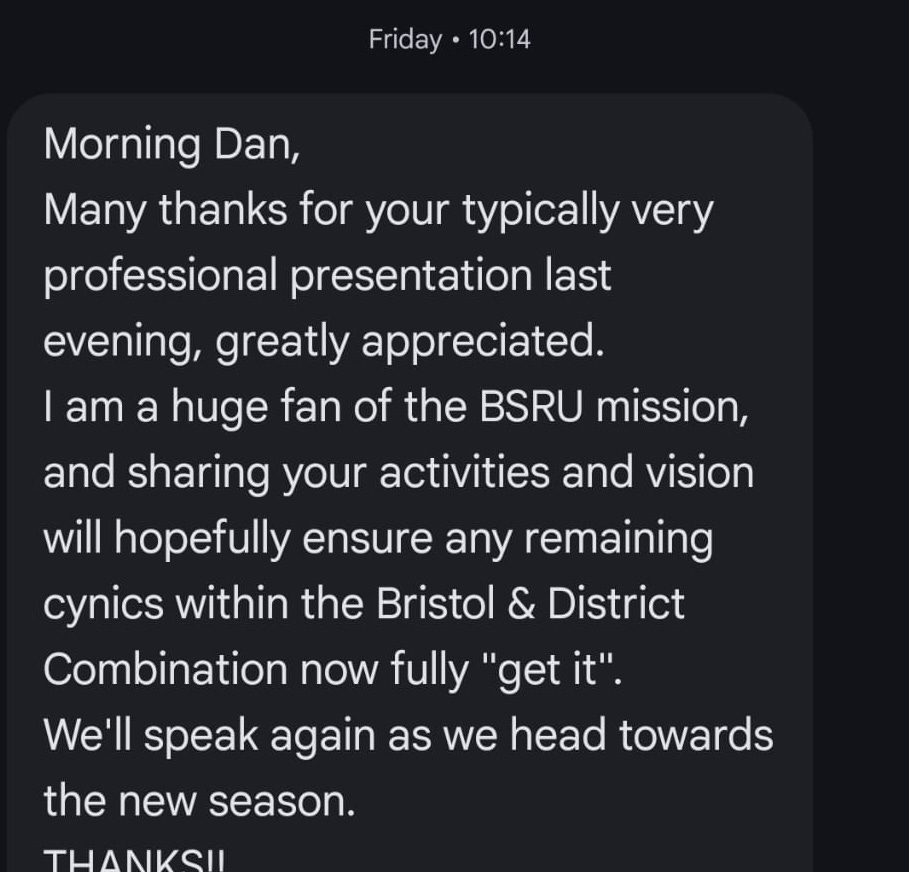
Last week I stood up in front of around 30 people from the Bristol and District Combination rugby teams at their AGM to explain the Bristol Schools U18 programme.
On the face of it, it should have been straightforward. Explain who we are. Tell them about the season. Share the results.
Instead, I found myself doing something quite different.
Afterwards, I realised I hadn’t really been talking about rugby at all.
Start by finding the room
The first thing I did wasn’t introduce myself.
I asked a question.
“How many of you have heard of the Bristol Schools programme?”
A handful of hands went up.
It sounds simple, but it changed everything.
Immediately I knew who I was talking to. More importantly, they were no longer passive listeners. They had participated. They’d made a small investment in the next few minutes.
It’s a reminder that every audience arrives with their own knowledge, assumptions and interests. Before you launch into your story, it’s worth finding out where they’re starting from.
Talk about what they care about first
The audience wasn’t there because they desperately wanted to hear about Bristol Schools.
They were there because they cared about rugby in Bristol.
So instead of explaining our fixtures and training sessions, I started with something we all valued: creating opportunities for young players and strengthening the future of the game.
Only once we’d established that common purpose did I explain where Bristol Schools fits.
I think that’s a lesson beyond public speaking.
People rarely buy into your project until they understand how it helps their priorities.
Explain the problem before the solution
It’s tempting to describe what you do.
“We train every Thursday.”
“We played seven matches.”
“We’ve got a leadership group.”
But none of that means very much without context.
Instead, I explained the challenge.
Many of our players don’t come from traditional rugby-playing schools. They’re enthusiastic players, but they haven’t always had the same opportunities or representative experiences.
Once the audience understood the problem, everything else made sense.
Leadership wasn’t another initiative.
It was part of the solution.
Our training programme wasn’t just about improving rugby skills.
It was about helping players discover confidence.
Philosophy before logistics
Looking back, I spent very little time talking about the mechanics of the programme.
Instead, I talked about what we believe.
That every player should have a meaningful playing experience.
That leadership needs to be scaffolded rather than expected.
That standards matter.
That belonging comes before performance.
Only then did I describe what we actually do each week.
I’ve realised that audiences don’t remember schedules.
They remember principles.
Show, don’t tell
One phrase seemed to resonate.
“It’s not about chat. It’s about action.”
Rather than claiming we develop leaders, I explained how we ask players to speak at dinners, contribute to the game plan and take ownership of the environment.
Rather than saying we value feedback, I talked about the conversations after training and matches.
Beliefs only become believable when people can see them in action.
The line that landed
At the end, I found myself saying something I hadn’t planned.
“These players aren’t just representing Bristol Schools.
They’re representing each other.”
Judging by the conversations afterwards, that was the line people remembered.
Not the wins.
Not the fixtures.
Not the training schedule.
The purpose.
A framework I’ll use again
Reflecting on the evening, I’ve scribbled down a sequence I’ll use whenever I’m speaking about a project that people know little about.
Find out who is in the room.
Connect to something they already care about.
Explain the problem you’re trying to solve.
Share the philosophy before the process.
Show what that philosophy looks like in action.
Finish with the change you’re trying to create.
Whether you’re speaking about rugby, business or education, most audiences aren’t asking, “What do you do?”
They’re asking a different question.
Why should I care?
If you answer that first, everything else becomes much easier.